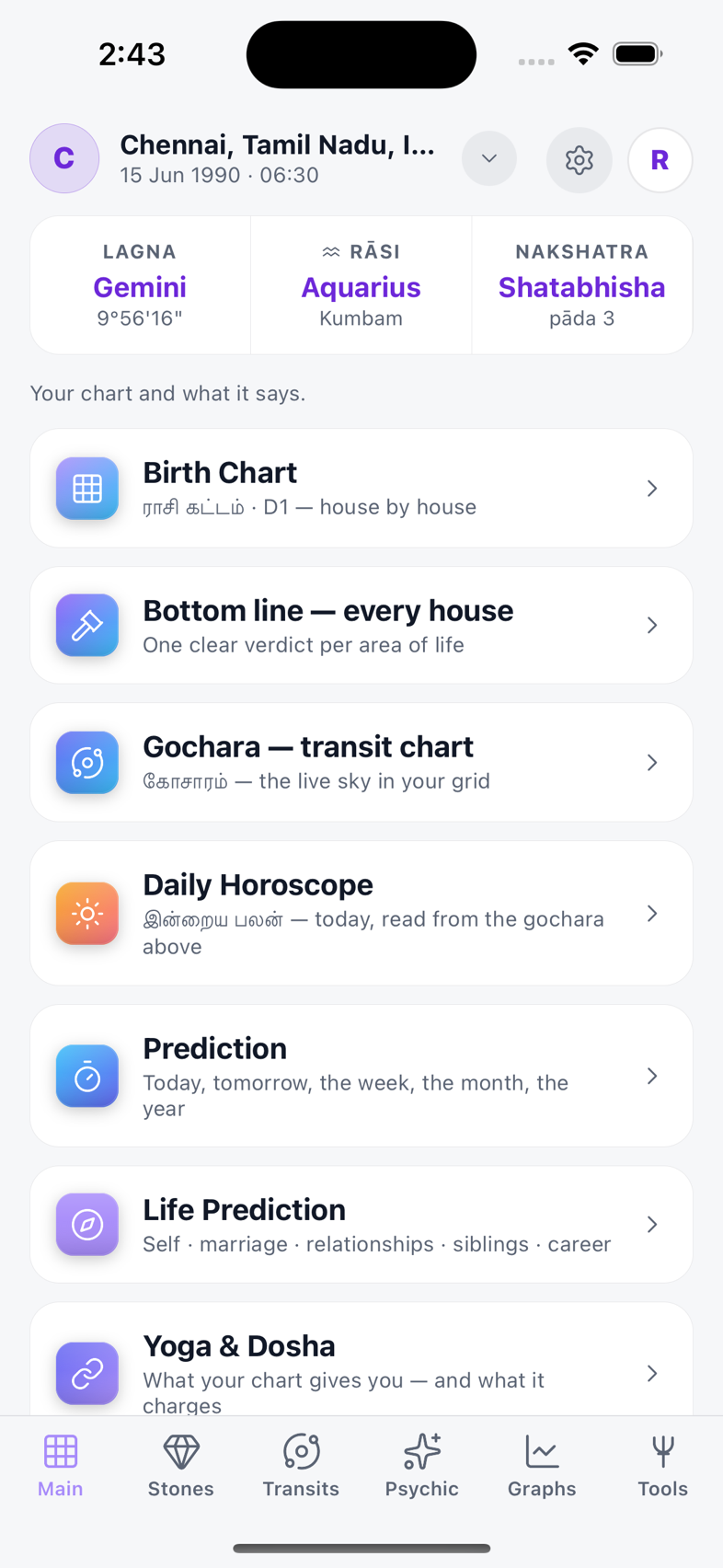
The astro super app for iPhone. One app carries the whole discipline — the sidereal chart cast from Swiss Ephemeris, readings reasoned from hundreds of sources, and a toolkit of real instruments: AR sky trackers, a LiDAR vastu scanner, the vedic compass, palm and body reading. Every claim shows its working, so a reading is something you can argue with rather than take on faith.
Astropedic casts the rāsi kaṭṭam from Swiss Ephemeris and then reads every house by the same eight checks, in the same order. What the house signifies, who owns it, where that owner went, what it found there, who lives in the house, whose sign the lord sits in, what is conjunct, and who is looking at it. Nothing is asserted without the step that produced it.
Not a sun-sign column. The Moon's position is counted from YOUR natal Moon — which is what gochara means — and judged against the classical transit tables. Sade Sati, Kaṇṭaka Śani, Aṣṭama Śani and Chandrāṣṭama are named by name when they apply. The score is taken apart on the same screen: every layer shows its own number and how much of the total it carries.
The Moon is in your 11th today — gains arrive easily, friends are generous, and desires are met.
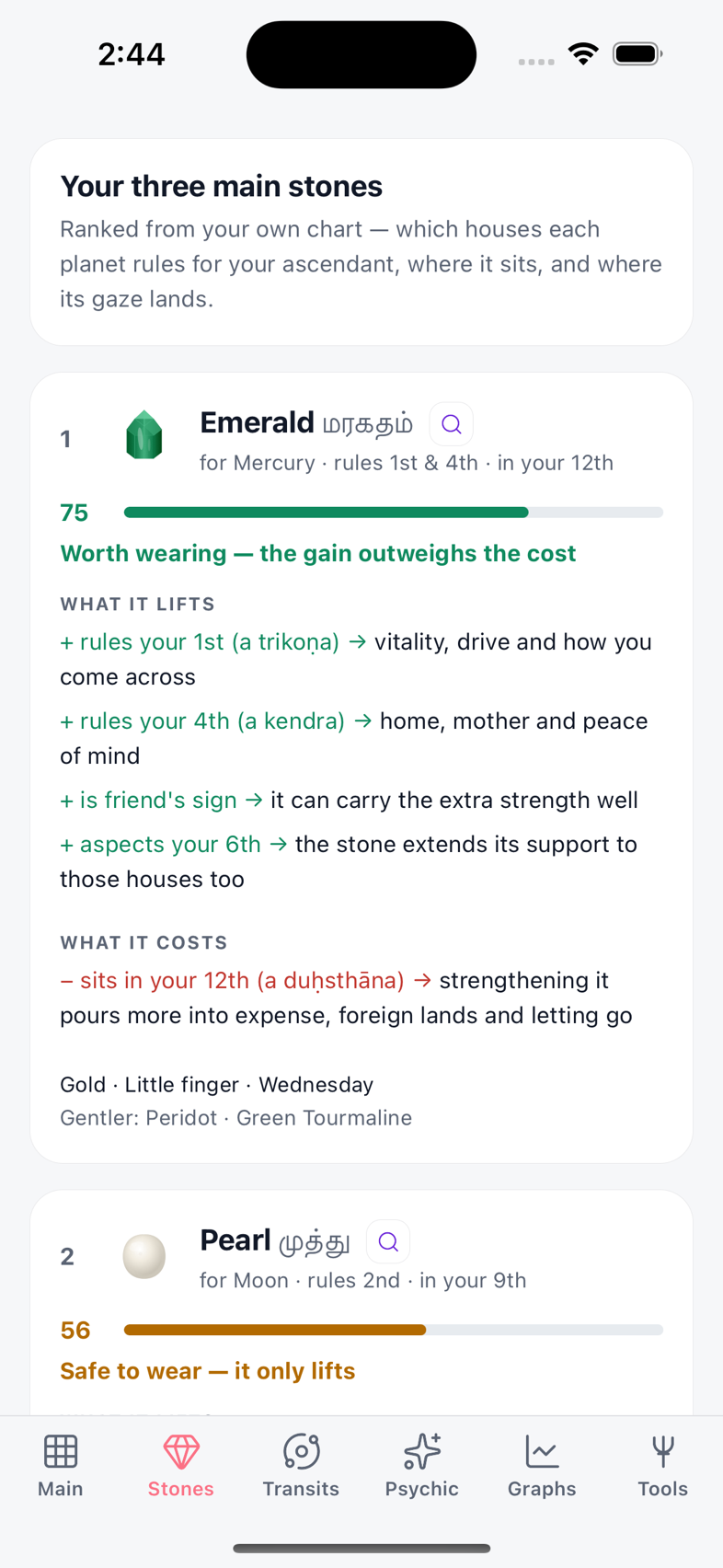
A reading that only diagnoses is half a reading. Astropedic grades every graha in your chart, then names the remedy the tradition prescribes for the ones running weak — the stone and what it costs as well as what it lifts, the bīja mantra, the breath practice, and the chakra that graha is seated in.
This one tells you where it got that. Every claim carries the rule that produced it and the text that rule came from, so you can follow the reasoning — or disagree with it.
Tap any statement and you get the reasoning behind it — which rule fired, and the tradition it comes from, drawn from hundreds of sources. No anonymous verdicts.
Positions come from Swiss Ephemeris with the Lahiri ayanāṁśa. Ṣaḍbala, aṣṭakavarga, daśā and gochara are computed, not approximated — and the engine says out loud when a component is missing.
Every house is read by the same eight checks, in order: what it signifies, who owns it, where that owner went, what it found there, who lives in it, whose sign the lord sits in, what is conjunct, and who is looking at it.
The Astropedic widget sits on your home screen with today's score, its band, the one-line reading and your best hour — computed from the live sky against your own chart, refreshed each morning. Glance, and you know whether to launch or to finish.
Jyotiṣa rests on one idea, and it is worth stating plainly rather than leaving implied.
The moment you drew your first breath, the sky had exactly one arrangement, and it will not have it again. The tradition treats that arrangement as a calibration — the instrument is set once, at the moment it starts running, and everything it registers afterwards is registered against that setting. This is why the birth time matters so much: the ascendant moves a degree every four minutes, and a chart set four minutes late is an instrument calibrated to a sky that was not there.
From there the model is one of resonance. Each graha is held to carry a quality — Mars heat and force, Śukra sweetness and appetite, Śani weight and time — and each is seated in one of the seven chakras, the body's own centres. A graha standing strong at your birth leaves its centre well supplied. A graha standing weak, or pressed by an enemy, leaves its centre thin, and the tradition reads the consequences there: Maṇipūra for the nerve to act, Anāhata for what you can feel, Mūlādhāra for the ground under you.
A transit, in this model, is not an influence arriving from space. It is the same note sounding again — the graha returning to a position that touches your original tuning, and the centre it governs answering. That is what the daily reading is measuring, and why it is counted from your natal Moon rather than from a calendar month.
The remedies follow from it. If a centre is running thin you feed it: the graha's bīja mantra, its stone, its breath, its note. Not because a stone transmits anything, but because the practice is aimed at the place the tradition says the deficit is.
About the frequencies below: they are not emissions. Nothing measurable reaches you from Saturn. Each number is the graha's own orbital period turned into a frequency and doubled until it lands in the range a human can hear — Hans Cousto's cosmic octave, 1978. The app shows every step of that arithmetic, and the note-and-bowl pairings are the modern sound-healing convention rather than anything the śāstras specify. We would rather tell you that than let a number do work it has not earned.
The chakra reading maps your chart onto the seven centres and shows which run low — and for each, the singing bowl that serves it: its note, its frequency, its approximate size.
Then it listens. Strike any bowl near your phone and the note detector hears the pitch, names the note, and tells you which chakra that bowl is for — so the bowl on your shelf and the centre that needs it find each other.
The reading engine draws on a knowledge base built from hundreds of sources — classical literature, commentaries and practice — refined rule by rule. Where the engine reasons for itself, the reading says so.
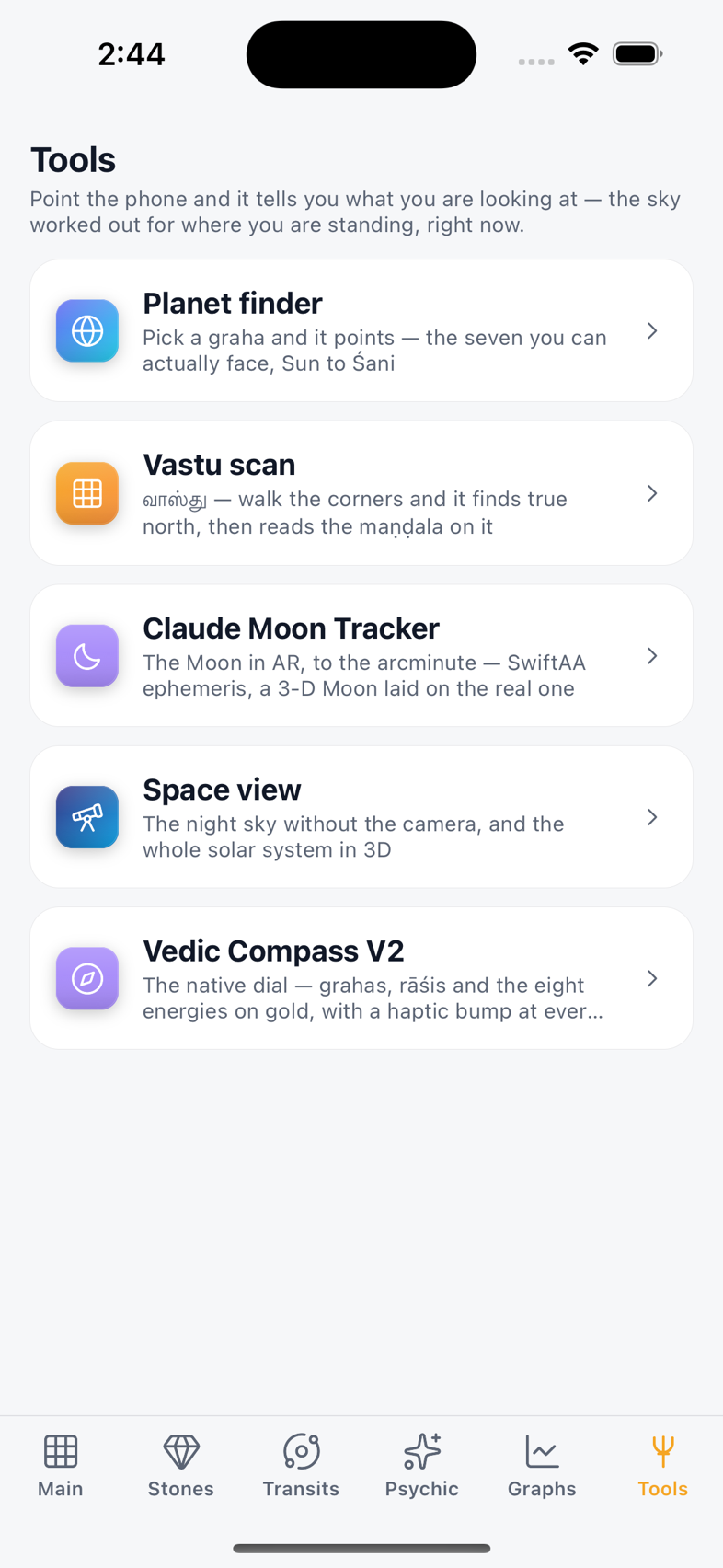
Readings are half of Astropedic. The other half is a toolkit of real instruments — AR sky trackers placed by a professional ephemeris, a LiDAR room scanner with sonar, a compass with the dikpālas on the dial. Not more pages of text: things you point, walk and hold up to the sky.
The Moon in AR — a 3-D Moon laid on the real one, placed by a professional ephemeris (SwiftAA / Astronomical Algorithms) to the arcminute, with its path across your sky drawn hour by hour.
Pick a graha and the phone points at it — Sun to Śani as lit 3-D globes on the live sky, with a Waze-style arrow walking you on.
The night sky without the camera — stand on the Earth and sweep the planets as textured globes, or step outside the solar system and see every orbit, today.
Walk a room and it is measured — LiDAR and RoomPlan where the phone has them, ARKit and an acoustic sonar cross-check where it does not — then the vāstu maṇḍala is laid over the real floor plan, with a heatmap, door verdicts and a house score.
The iOS-grade compass with the dikpālas on the dial — Īsāṉi mūlai to Vāyu mūlai, true north said out loud, nakshatra ring turning with the sky.
Your planet lines on the world map — where each graha's power sits geographically, and what living on a line does.
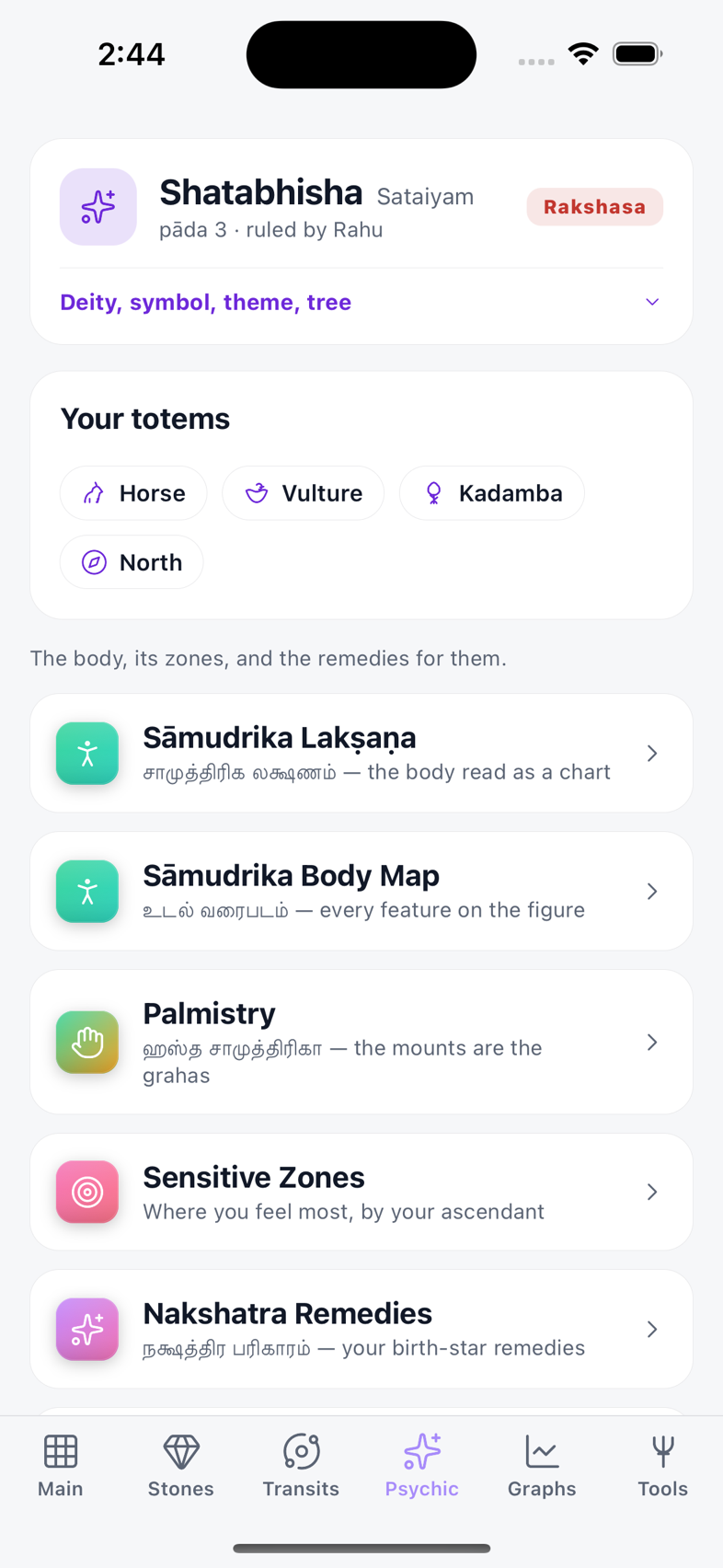
Hasta-sāmudrika from a photographed palm and the full sāmudrika body map — the mounts read as the grahas they are.
Today's reading on the home screen before the app is even opened.
The menus, exactly as they ship — every tile above is in the app today.
The chart itself is free, and stays free. Paid tiers add the tools you reach for once you know your way around it.
The whole chart, read properly. Everything you need to understand your own horoscope.
51 features included
The working tools — transits over any date, the full life graph, gems and remedies timed to your chart.
60 features included
Everything, including the readings that take real computation: the narrated life story, karmic record, astrocartography and praśna.
65 features included
Prices in USD. On iPhone your App Store storefront's own price applies and Apple bills it; subscriptions renew until cancelled.
Sidereal, with the Lahiri (Chitrapakṣa) ayanāṁśa — the standard for Jyotiṣa. Positions come from Swiss Ephemeris.
The closer the better. The ascendant moves about one degree every four minutes and changes sign roughly every two hours, so an hour's error can move every house.
A knowledge base built from hundreds of sources — classical literature, commentaries and practice — plus the engine's own reconciliation where the sources are silent. Rules the engine derived are labelled as derived.
Your birth details are held on your device. They are sent to the server to be computed and that request keeps nothing — the only trace is a one-way hash used to count how many charts you have cast. They are stored on the server only if you deliberately save a chart to your account, and deleting your account deletes them.
Yes. The chart and its readings are free. Paid tiers add lite, premium — the pricing section lists exactly what each one unlocks.
No. It reads a chart against a tradition and says what that tradition holds. It is offered for reflection and study, not as advice — and never as medical, legal or financial advice.